HOME OF THE OCTOPUS TEACHER
The Great African Seaforest
Darwin’s warning has arrived. Today, 60% of the world’s kelp forests are degraded and declining. Over half have disappeared in our lifetime. When kelp goes, entire ecosystems collapse and the ocean loses one of its most critical defences.
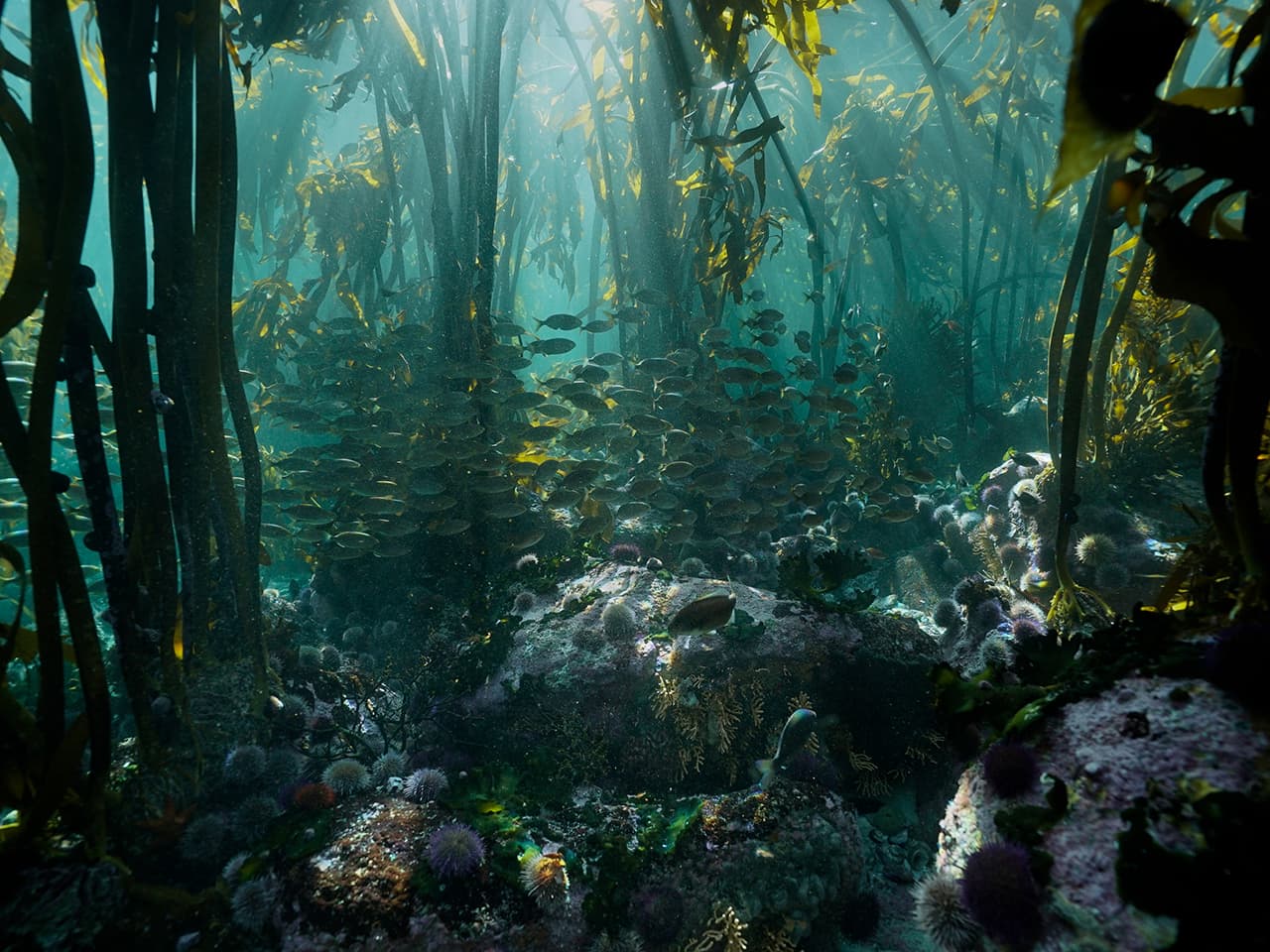
The Great African Seaforest, home to My Octopus Teacher, is the only forest of giant bamboo kelp on the planet — an underwater wonder of otherworldly creatures, startling abundance and rich biodiversity.
It fringes the shores of Cape Town and stretches north for more than 1000km into Namibia. Fed by the nutrient-rich Benguela Current, it is one of the world’s last intact kelp ecosystems, and unlike many kelp forests that are shrinking or disappearing, it is thought to be growing. With over 30% of its species found nowhere else on Earth, it is proof of what protection makes possible.
Together, through My Octopus Teacher, we helped make this underwater world visible to millions and gave it a name the world could hold onto. That’s how the Great African Seaforest came to be. That was the first step: making people fall in love with something they couldn’t see.
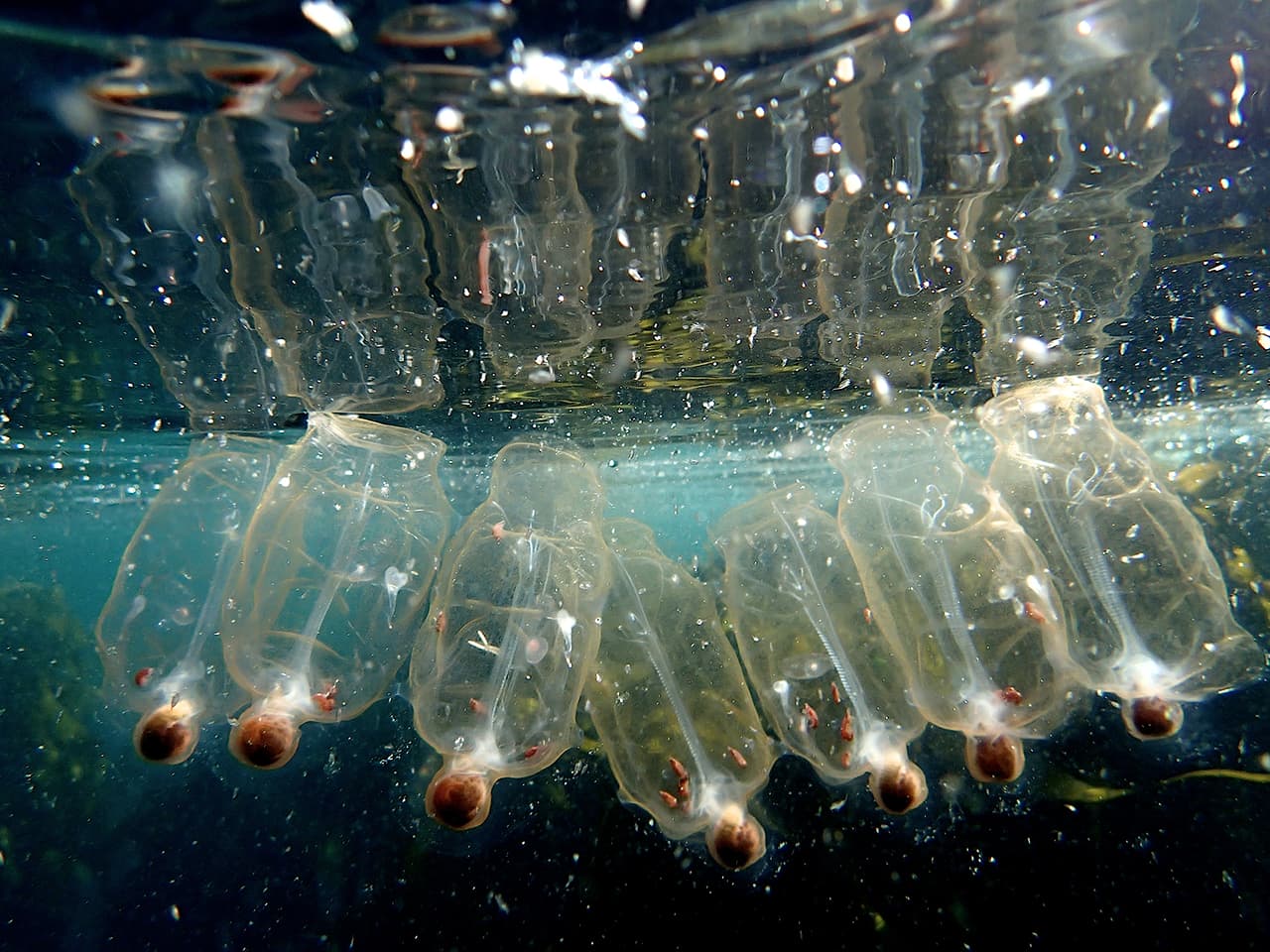
What excites us most about this ecosystem is its mystery. So much of the Great African Seaforest and its inhabitants remain unstudied, making it a place where new species and animal behaviours can be discovered almost daily. This awakens our curiosity and deepens our connection to the natural world. Our 1001 Seaforest Species project, in partnership with the Save Our Seas Foundation, aims to document the myriad species that live in the Great African Seaforest, shining a light on their biology and lives to highlight why preserving this unique habitat is so vital.
“What’s so amazing about this environment is you’re in a three-dimensional forest and you can jump off the top and go anywhere you want, you’re flying basically…The animals are exotic and strange. It’s much more extreme than our maddest science fiction.”
CRAIG FOSTER
ABOUT KELP FORESTS
Kelp forests are highly productive near-shore marine ecosystems and play a critical role in maintaining a stable climate.
Kelp forests are foundational ecosystems that historically fringed 30% of our global coastlines. They are critical and prolific inshore habitats that remain largely invisible in comparison to other iconic natural systems such as rainforests or coral reefs. They play a pivotal, irreplaceable role in shaping the ecosystems around them by creating three-dimensional, vertical habitat structures that support a diverse array of organisms. This physical complexity drives high species richness and abundance.
Kelp forests influence local hydrodynamics, nutrient cycling and carbon storage. Many organisms depend on them at various life stages, for example, juvenile fish seeking shelter, invertebrates feeding on detritus, herbivores grazing on algae. When kelp declines, the effects cascade through the entire food web, affecting predators and overall ecosystem productivity.
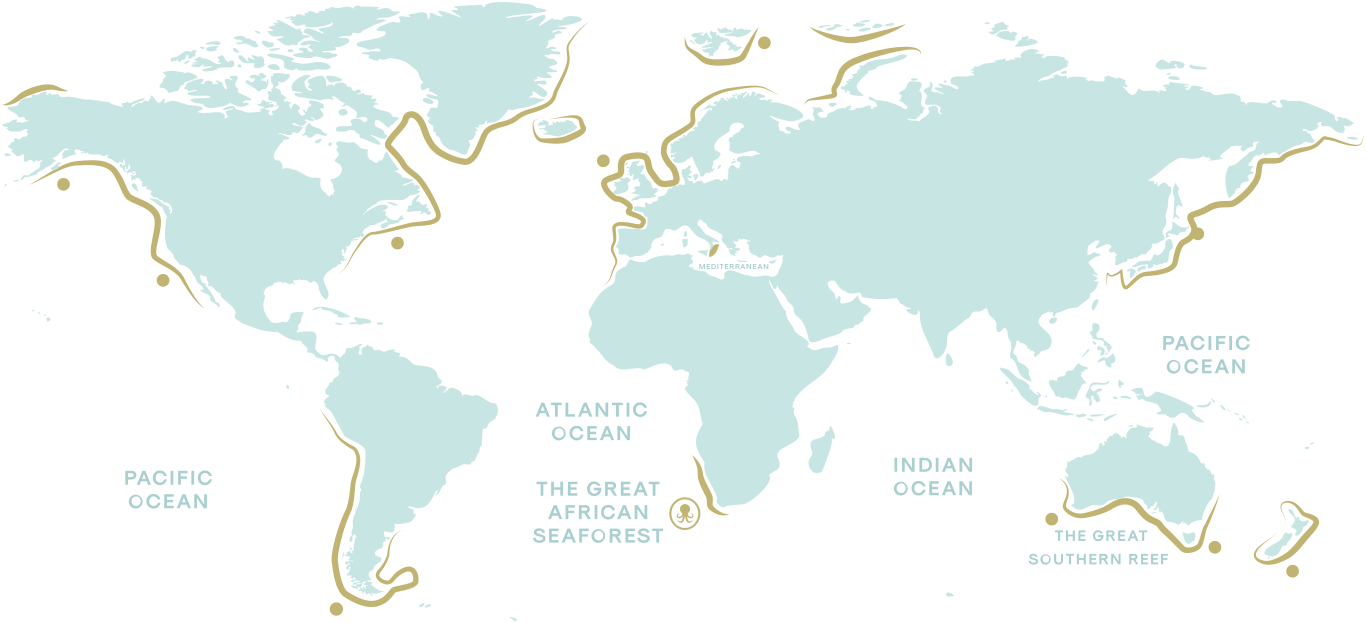
Kelp Forests are in trouble. In the past few decades, more than a third of the world’s assessed kelp forests have declined. Scientists estimate we’re losing about 2% of global kelp forest cover every year. Many have collapsed into urchin barrens – or meadows of turf algae carpeting the sea floor. These shifts are considered irreversible. They are vastly understudied and under-explored. There is a need to recognise these highly productive seaforests in their own right and urgently work towards preservation and restoration
They may be the ocean’s most important story yet to be told.
THE GLOBAL KELP FOREST MOVEMENT
Why the Great African Seaforest is Important
We are laying the foundation for a coordinated global kelp movement, bringing together founding partners Mission Blue and the Kelp Forest Alliance. This is a collaborative effort by design, welcoming partners from around the world to contribute their own expertise, stories and sea forests to a shared cause. New partnerships are already emerging.
The movement unites scientists, filmmakers, ocean storytellers and institutions around a single conviction: local knowledge, connected globally, drives real change. Local stories carry authenticity and legitimacy. When told by the people closest to these ecosystems, they inspire action – and when linked across regions, they shape policy, shift awareness and secure protection at scale.
Our shared goal is clear: international recognition of kelp forests as a unique and critical ecosystem, and their protection before it is too late.
PROTECTION & REGENERATION
Uniting scientists, filmmakers, and institutions around international recognition and protection of kelp forests.
THE HUMAN SPECIES HAS AN ANCIENT HISTORY WITH THE GREAT AFRICAN SEAFOREST
The oldest archaeological evidence of art and science has been found here. It is thought that this coastline gave rise to the birth of human consciousness as we know it. This environment is part of every human being’s origins.KELP IS CONSIDERED A FOUNDATION SPECIES AND ECOSYSTEM ENGINEER
The two dominant canopy-forming kelp plants in the Great African Seaforest are the sea bamboo Ecklonia maxima and the Split-fan kelp Laminaria pallida.KELP PROVIDES REFUGE, SHELTER, AND FEEDING GROUNDS
As a three-dimensional ecosystem, it provides home, shelter, nursing, and feeding grounds for thousands of species, including the Octopus Teacher’s descendants. A large number of these species are endemic to the region, with many yet to be described.KELP HELPS REGENERATE THE OCEANS
Kelp forests have been identified as key ecosystems for regeneration in the world’s oceans.KELP REDUCES CO2 IN THE WATER
The carbon sequestered by kelp forests is comparable to that of mangroves, salt marshes, and seagrass meadows combined. Reducing the amount of CO2 in the water also reduces local ocean acidification, making the seaforest a refuge for marine life.KELP PROTECTS THE COASTLINES
The kelp forest protects our coastline from storm surges and rising seas, mitigating coastal erosion.KELP HELPS US CONNECT TO THE WILD
It is a wild space for people to visit and connect to, reminding us that we are part of the natural world.Resources
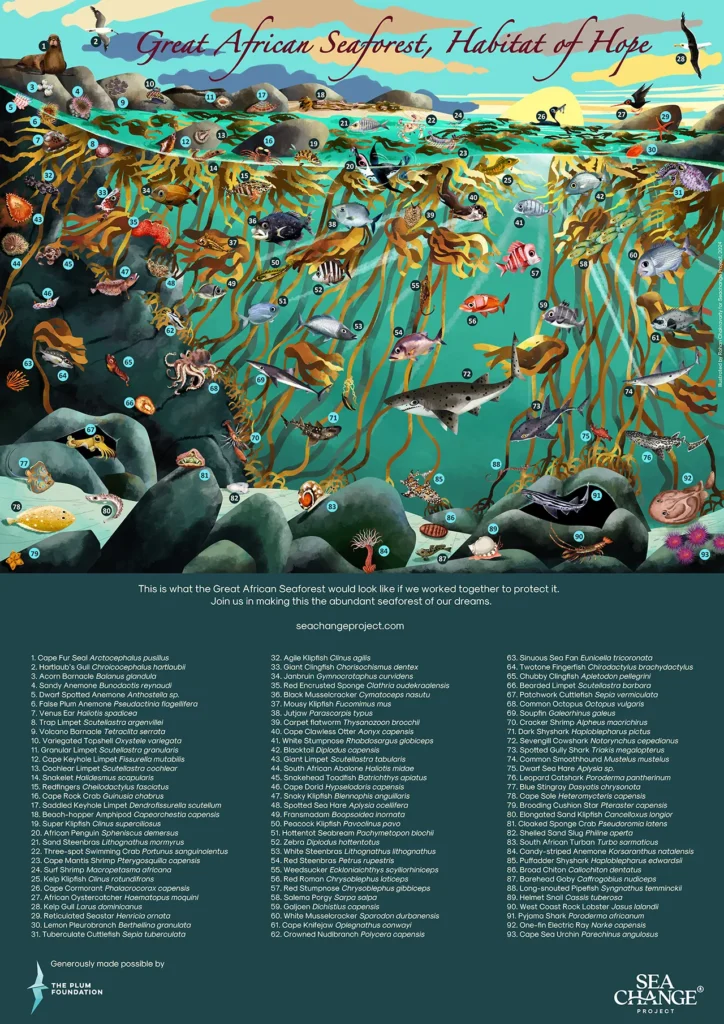
Great African Seaforest, Habitat of Hope
Travel back in time with us to the Great African Seaforest of a century ago. Take a deep breath at the surface and descend through moving clouds of colourful reef fishes. To the left, a big shoal of lightning-fast Galjoen darts past; to the right, a huge school of Red stumpnose streams past in an endless river of red and white. Cutting through the middle, a massive Red steenbras as big as a human charges forward, while large sharks patrol the ledges below. Those ledges are covered in huge, algae-covered abalone – so many that you can’t see the rocks to which they are attached. Drift lower still and peer under a ledge to find an army of giant crustaceans: countless Cape rock lobsters jostling for space in the overcrowded crack.
Every new generation has experienced a different version of the kelp forest. The numbers of larger, commercially valuable animals, such as reef fishes, lobster, and abalone, have steadily declined over the years. In their place, invertebrates such as urchins and starfish have thrived. The Great African Seaforest is still brimming with life — so much so that we are still discovering new species. But it is far from pristine.
Our Great African Seaforest Habitat of Hope represents the kelp forest of our dreams: a balanced ecosystem rich in biodiversity and abundance for the benefit of fishing communities, tourists, divers and our wonderful ocean kin.
Global Kelp Forests Under Pressure
Threats Facing the Great African Seaforest
Perhaps the most pressing is a lack of knowledge and awareness.