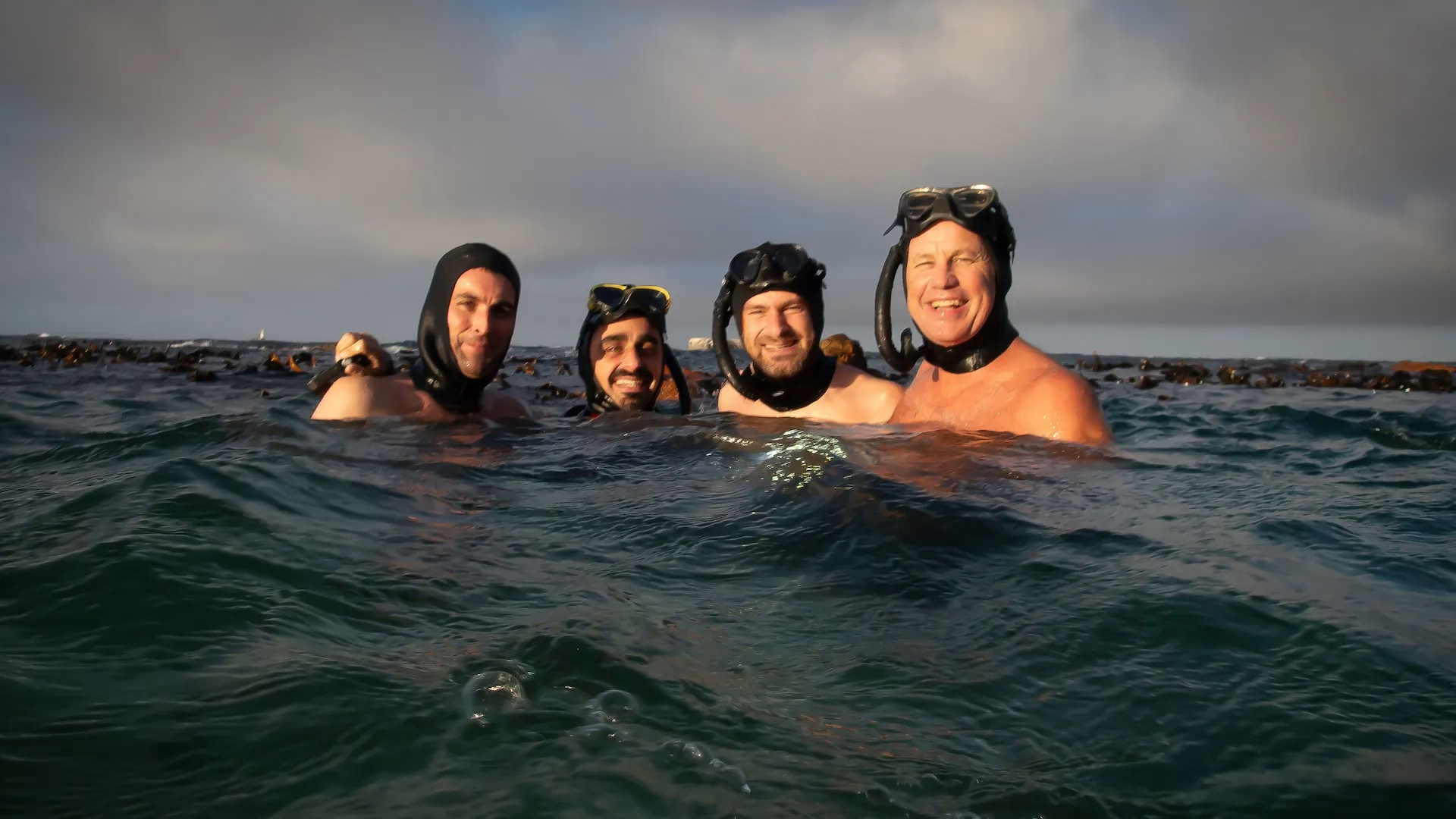
Unlike the Holdfast and eDNA projects, the Octopus Project was initiated by us, though it quickly became clear that expert collaboration would be essential. During the making of My Octopus Teacher, Craig, Jannes, and the team relied on deep, field-based knowledge of octopuses in the Great African Seaforest. Jannes always felt that some of these insights, gained through direct experience in nature, should be translated into scientific research. With support from local and international experts, including geneticists and cephalopod specialists, we continue to explore octopus biology and broader cephalopod diversity in South African waters.
After the film’s release, marine biology student Gareth “Gaz” Fee approached Jannes, eager to explore octopuses for his dissertation. Gaz first worked on a project with Jannes and octopus cognition expert Professor Jennifer Mather, investigating whether octopuses could adjust the precision of their drilling depending on the shells they targeted. For his MSc., Gaz shifted focus to a genetic and morphological study to inform taxonomy, for which Rouane Brokensha helped with field work. We hypothesize that the South African octopus, beloved by millions of Netflix viewers, may represent a distinct species lineage, separate from the European “true” Common Octopus (Octopus vulgaris), and therefore scientifically undescribed.
Testing this idea required broader expertise. Prof. Peter Teske and his post-doc Arsalan Emami-Khoyi contribute genetic analyses, while international cephalopod specialists Drs. Alvaro Roura and Michael Amor share their experience from similar research. In 2024, we invited Alvaro and Michael to Cape Town, and the knowledge exchanges that followed sparked multiple new research opportunities. Since then, we have been pursuing several smaller cephalopod projects, all aimed at deepening our understanding of this fascinating group in South African waters.
South Africa is especially rich in cephalopods, with over 200 species recorded in national waters. Yet, deeper taxonomic knowledge is still limited, and ecological or behavioral studies are nearly absent. Correctly identifying our local species is a crucial first step for building sound scientific understanding, a view that is shared and supported by the South African government (DFFE) as well as the local octopus fishery. The urgency is growing: human demand for natural resources is rising, and octopuses, as well as cephalopods in general, are becoming an increasingly important global fishery. In False Bay alone, roughly 70 tonnes of octopuses are caught annually in a local fishery.
While our efforts are ongoing and can sometimes feel slow, we are hopeful that by combining international expertise with our local, field-based knowledge, we can make meaningful contributions to understanding and safeguarding these species. In doing so, we aim to generate knowledge that benefits both science and the seaforest ecosystem. Cephalopods are some of the most exciting animals to study, and we feel privileged to be their stewards. We are deeply grateful to learn from these remarkable creatures, and to work alongside incredible biologists who help us interpret our observations.
By signing up for the newsletter, you agree to the Terms and Conditions.
By signing up for the newsletter, you agree to the Terms and Conditions.